
Seal 8
ZAI · Creativity
See what happens when one condition changes.
Why a first idea can crowd out a second
As soon as you recognize a problem, a familiar solution often comes to mind. Familiarity is useful. It lets you get ordinary things done. It also makes it easy to accept the first possibility before you have seen what else could work. ZAI asks you to spend a little time with the conditions of the problem while the answer is still open.
Creativity begins with a change you can make. A task might require a quiet place, but does it have to be done at a particular hour? It might require two people, but do they have to be in the same room? Changing one condition at a time helps you see which limits belong to the task and which came with your first idea.
Give imagination space
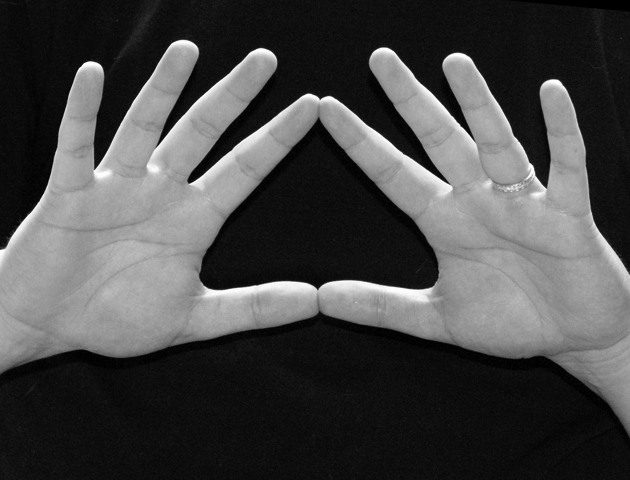
Face your palms forward and spread the fingers. Let the tips of both thumbs meet, then bring the tips of both index fingers together. The thumbs and index fingers outline a triangle. Leave the other fingers open. Hold the gesture at a height where your shoulders can rest.
Bring attention to the centre of your forehead at the upper bridge of the nose. Say, “Everything, everywhere.” Picture white in every direction. In RETSU you distinguished the nearer and farther spheres. For ZAI, let their outlines disappear until the whole field is white. If the outline of an object comes back, allow it to fade and return to the open field. You can remember the idea of white space even with a faint image.
In the second book, ZAI invites contemplation of the elements of creation. Begin with a property you can observe. Water takes the shape of the space that holds it. In a practical problem, what could change shape while keeping its purpose? Allow one such question to occupy your attention after the sitting. It gives imagination something definite to work with.
The Sanskrit mantra
Om srija iva rutaya swaha
Keep the field open while you recite. You can leave an unfinished idea unfinished through one repetition. That small interval of uncertainty gives a second possibility time to appear. If nothing occurs to you, finish your sitting anyway. Leave the choosing and testing for the work that follows.
Test one possibility
Write down the result you want in one sentence. Name two ways you could try for it. Choose the smallest part of one idea that can be tried today. For instance, before reorganizing a whole room, clear one work surface and use it once. See what became easier and what you had to reach for. What you learn from a small trial can change the next idea.