
Seal 7
RETSU · Perception
Look again from where someone else stands.
How attention selects a view
What you notice depends partly on where you direct your attention. Look at one object close to you. Its edges and details become easy to describe. Keep your eyes in the same position and notice the space around it. Something that was present all along may now come into awareness. The room has stayed the same. You changed the size of the view you were attending to.
The same selection happens when you remember an event. A remark that upset you may be the part you remember most clearly. You may have missed what happened just before it. RETSU gives you practice in moving between a detail and its setting. This also helps you recognize the point at which observation ends and interpretation begins.
Work with two distances
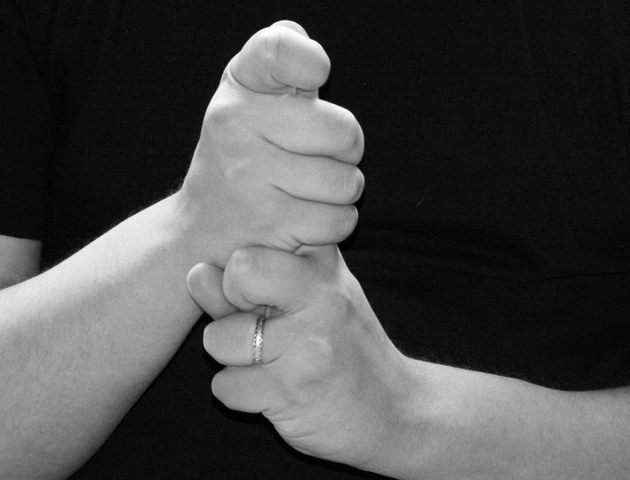
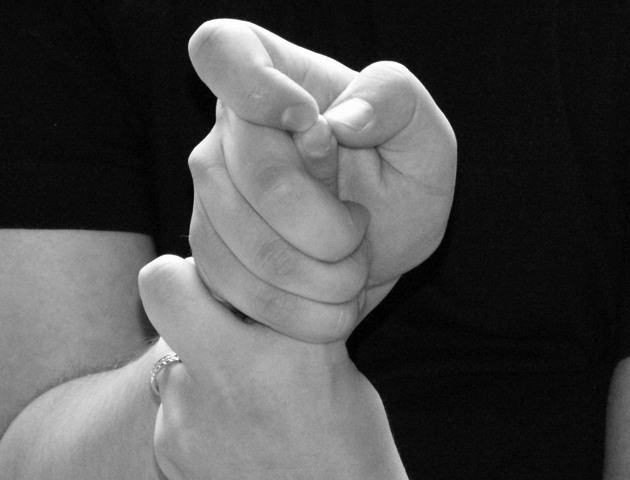
Make a loose fist with your left hand and extend the left index finger upward. Wrap the right fingers around the raised finger. Bring the tips of your right thumb and right index finger to the tip of the left index finger. Use the photograph to check the orientation, then let your hands rest at an easy height.
Bring attention to the bony point at the back of the head where the skull meets the neck. In the second book this focus is called the Jade Gate. Direct your attention there gently while your head stays level. Say, “Many levels.” Picture the blue sphere turning white and dividing in two. Let the outer sphere grow wider. Let the inner one draw in until it follows the shape of your body.
Begin with the nearer boundary. Notice the space your hands and body occupy. Then include the larger space around you. If holding both images at once is difficult, move between them. Eventually you may be able to keep the nearer one in mind while allowing the wider one to remain in the background. That change in attention is the exercise.
The Sanskrit mantra
Om jyota-hi chandoga jiva tay swaha
Recite with the wider space in mind. Then give the nearer space a repetition. Notice which one you tend to lose when you attend to the other. The philosophy of RETSU invites you to allow for more than your present view can contain. In daily life that means leaving room to learn something that your current position makes hard to see.
Check an interpretation
Use two short sentences about one real event. In the first, say what you observed. “My question received no answer.” In the second, say what you took that to mean. “I thought the person was annoyed.” Look for one piece of information that would help you tell. You can ask whether your question was heard. A wider view sometimes begins with that small distinction.