
Seal 2
KYO · Responsibility
Find the part of a situation you can change.
Find your part
Responsibility becomes easier to understand when you separate what happened, what you did, and what you can influence now. If you missed an appointment, the time has passed. You can still make a call. Blaming yourself may take ten minutes without changing anything. Making the call takes one of the means available to you and puts it to use.
KYO follows trust because it asks you to do something with the capacity you recognized in RIN. Look closely at the word “my” in “my responsibility.” Other people make decisions of their own. You can ask a clear question, change how you speak or withdraw from an exchange. You can also acknowledge the effect of something you did, including a good effect. Knowing which part belongs to you keeps your effort useful.
Follow the movement outward
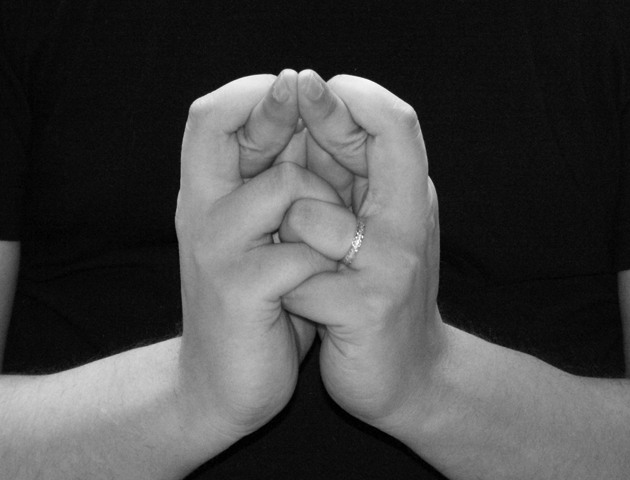
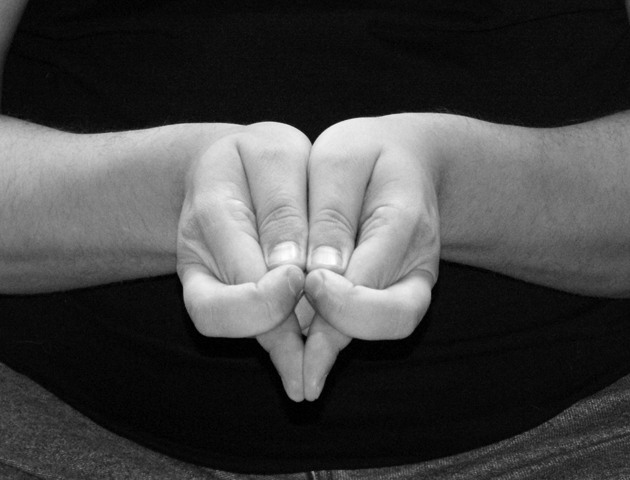
Bring your hands together. Point both index fingers upward and curve the middle fingers over them. Bring the thumb tips together and weave the remaining fingers. Use the photograph to find the arrangement, then let your wrists settle.
Bring your attention to the lower abdomen, between the pelvis and the navel. Picture a small orange sun there, radiating light in every direction. Let the belly move gently with your breath. In Qi-Gong, the inner region of the lower belly is called the Dan-tian, a place where Qi is gathered in practice. For KYO, keep the centre in one place and allow the imagined light to travel outward. That distinction gives you a way to feel where an action begins and the direction it takes.
Say, “Many means and methods.” Let one possible response come to mind. Keep breathing long enough to find a second. For example, you can give an answer now, or ask for the information that would let you give a better answer tomorrow. The second possibility often becomes apparent when you stop insisting that the first one has to work.
The Sanskrit mantra
Om isha naya yantraya swaha
As you recite, consider the tone in which you are about to act. A sharp voice and a calm voice can carry exactly the same request. In the Qi-Gong teaching of KYO, what you send outward matters. You can observe this directly by listening to your voice and, later, by paying attention to the reply. Leave room for the other person to surprise you.
Check the effect
Choose one action that is actually yours to take. Once you have taken it, compare the effect you intended with what happened. If your instructions were misunderstood, ask which part was unclear. That answer shows you which words to change. Responsibility includes the freedom to adjust what you do when the result teaches you something.